Stop Asking, “Which Curriculum Is the Best?”
Stop Asking, “Which Curriculum Is the Best?”
Parents comparing preschools often begin with the same question: “Which curriculum is the best - Montessori, Reggio Emilia, or Waldorf?”
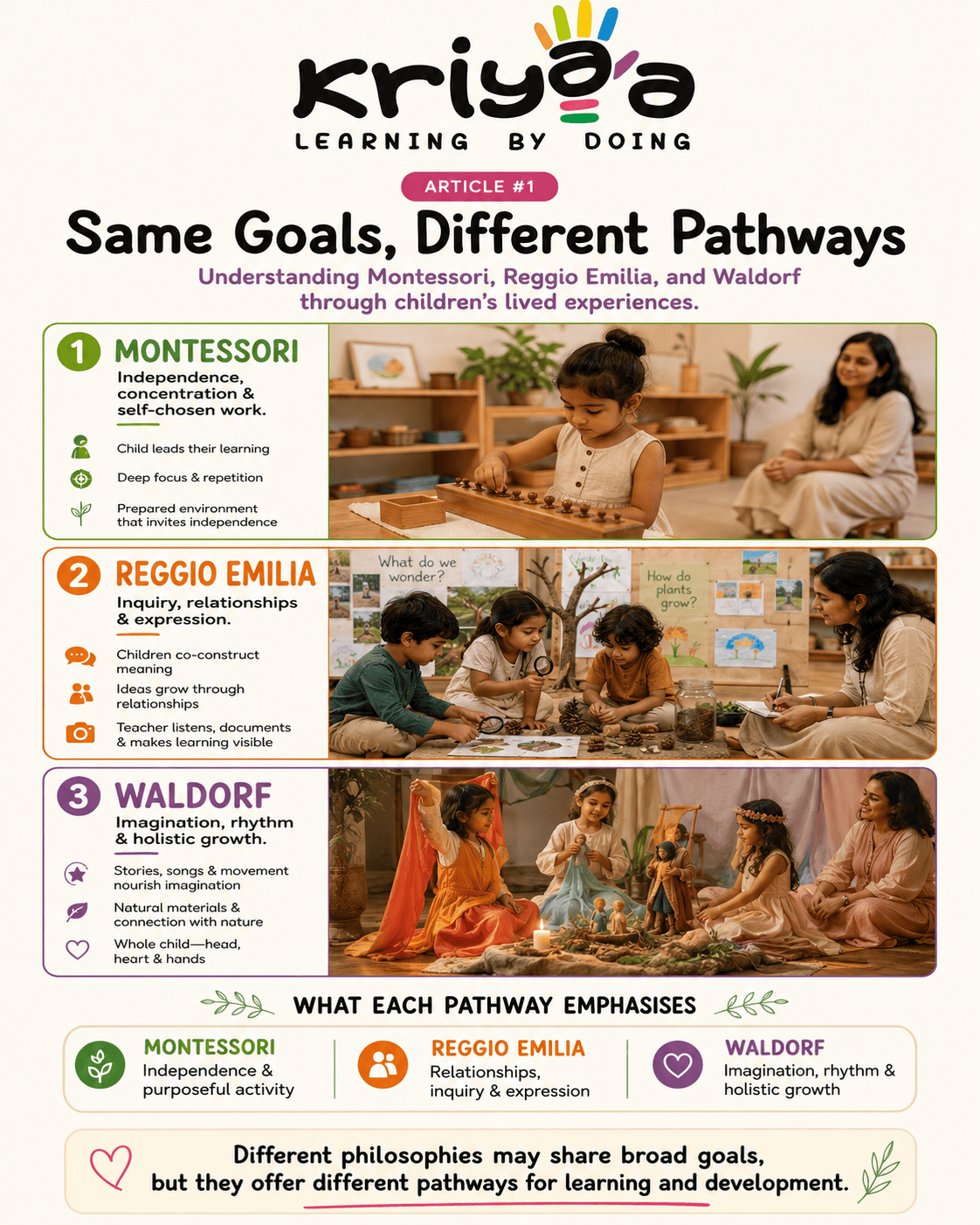
It sounds like a simple comparison. But these approaches are not competing brands offering different versions of the same product. They reflect different philosophies of childhood: different beliefs about how children learn, how adults should guide them, how environments should be organised, and which experiences deserve emphasis.
Most reputable early-childhood approaches share broad aspirations. They want children to become capable, curious, confident, expressive, socially aware, and increasingly independent. The important difference is how each philosophy believes those qualities develop.
Montessori: purposeful independence
Montessori: purposeful independence
Montessori places strong emphasis on independence, concentration, purposeful activity, and a carefully prepared environment. Children choose from appropriate work, receive precise presentations, repeat activities, and use materials intended to support progressive understanding. The adult observes, presents, protects concentration, and intervenes thoughtfully rather than directing every step.
A high-quality Montessori environment is therefore not defined by wooden objects or neutral colours. Its quality becomes visible in the relationship between child, adult, material, and environment - including whether the child can act independently and, where appropriate, notice and correct errors without constant adult judgement.
Reggio Emilia: inquiry through relationships
Reggio Emilia: inquiry through relationships
The Reggio Emilia Approach begins with an image of children as capable, rights-bearing participants in learning. Children develop ideas through relationships and through the “hundred languages” - many forms of expression and meaning-making, including talk, drawing, movement, construction, dramatic play, clay, and music.
Educators listen, document, interpret, and prepare possibilities for deeper investigation. Documentation is not simply a display of finished work. It helps children and adults revisit questions, theories, and changes in thinking. A Reggio-inspired setting should therefore show children co-constructing ideas, using multiple forms of representation, and participating in sustained inquiry - not simply completing open-ended activities.
Waldorf: rhythm, imagination, and lived experience
Waldorf: rhythm, imagination, and lived experience
Waldorf early-childhood education places particular value on rhythm, story, imaginative play, movement, nature, artistic experience, imitation, and purposeful practical work. These experiences arise from a holistic view of development rather than from the belief that young children should not learn.
A Waldorf setting may look less formally academic than a conventional classroom, but learning is embedded in shared stories, songs, movement, seasonal rhythms, practical activity, and community life. Parents should still ask how the school introduces literacy and mathematics, observes progress, and responds to individual needs.
The better question
The better question
A philosophy matters, but a label does not guarantee quality. Two schools using the same name may provide very different daily experiences because implementation depends on educator preparation, relationships, leadership, routines, materials, assessment, and partnership with families.
So instead of asking only, “Which curriculum is the best?”, ask:
A stronger school-selection question |
During a preschool visit, observe what children actually do, how educators speak with them, how choices and boundaries are handled, how play and intentional teaching are balanced, and how language, literacy, mathematics, movement, creativity, relationships, and individual needs are supported.
A curriculum label can begin the conversation. It should not make the decision for you.
Kriyaa perspective
Kriyaa perspective
Kriyaa studies educational traditions for the principles they reveal rather than as labels to reproduce. We draw thoughtfully from established approaches while remaining attentive to contemporary research, the Indian educational context, and the quality of children’s lived learning experiences.
 +91 88008 70177