John Hattie
Kriyaa Collaboration 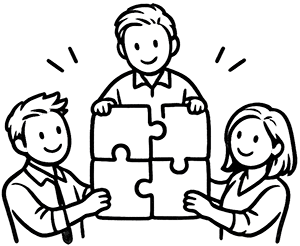
We focus on Visible Learning. Our progress mapping allows students to see their own growth.
The Bibliography 
Visible Learning (2008).
In a world of endless educational trends, which ones actually work? John Hattie’s "Visible Learning" is the result of the world’s largest evidence-based study into what improves student achievement. His core insight is that learning must be made "visible"—teachers must see learning through the eyes of their students, and students must see themselves as their own teachers. By focusing on high-impact strategies like feedback and self-reported grades, Hattie moved the needle from "teaching" to "impact." His work challenges us to ensure that every educational interaction leaves a measurable, felt trace on the learner’s journey.
The Kriyaa
Conclusion 
We make sure the "impact" of every lesson is seen and felt.
Sweller, Kirschner, Clark & Willingham
Kriyaa Collaboration
We apply Cognitive Load Theory. We strip away classroom distractions so the child can focus on the core concept (e.g., just the beads on a Rekenrek).
The Bibliography
Why Don't Students Like School? (Willingham, 2009).
John Sweller
Ever wondered why a cluttered worksheet makes a child shut down? John Sweller’s "Cognitive Load Theory" explains that our working memory is strictly limited. If the "noise" of a task outweighs the "signal," learning stops. Sweller’s research into how the brain processes information led to the realization that instructional design must minimize unnecessary distractions to maximize "germane" load—the mental effort used to build permanent schemas. His work is the ultimate argument for minimalism in education, proving that when we simplify the delivery, we amplify the understanding.
Paul Kirschner & Richard Clark
Discovery is exciting, but is "unguided" discovery effective? Paul Kirschner and Richard Clark are the leading voices advocating for "Fully Guided Instruction." They argue that for novices, pure discovery learning can be inefficient and even frustrating because it overwhelms working memory. Their research highlights that providing clear models, worked examples, and direct guidance actually empowers students to eventually become independent problem-solvers. Their work serves as a vital reminder that "doing" only leads to "learning" when it is backed by a solid, evidence-based instructional framework.
Daniel Willingham
"Memory is the residue of thought." This profound insight from cognitive scientist Daniel Willingham suggests that children only remember what they actually think about. Willingham’s work bridges the gap between laboratory brain research and the classroom, debunking popular myths like "learning styles." He argues that stories, context, and prior knowledge are the essential "hooks" that allow the brain to store new information. His contributions remind us that if we want children to master a concept, we must design experiences that compel them to engage deeply with the underlying meaning.
The Kriyaa
Conclusion
We design for the brain’s architecture, preventing overwhelm and promoting deep memory.
Benjamin Bloom
Kriyaa Collaboration
Our activity cards move from "Recall" to "Create" using Bloom’s Taxonomy.
The Bibliography
Taxonomy of Educational Objectives (1956).
Education should aim higher than the simple memorization of facts. Benjamin Bloom’s "Taxonomy" provided a roadmap for moving students from low-level "remembering" to high-order "creating." By categorizing learning into a hierarchy—Recall, Understand, Apply, Analyze, Evaluate, and Create—Bloom gave educators a language to push beyond the textbook. His philosophy suggests that mastery isn't just about knowing the right answer; it’s about having the cognitive flexibility to use that knowledge to build something entirely new. His work remains the gold standard for designing curriculum that challenges the whole mind.
The Kriyaa
Conclusion
Kriyaa takes a child from knowing a fact to building a world with it.
Howard Gardner
Kriyaa Collaboration
Our Multiple Intelligences approach ensures we have Soundcases for the linguistic learner and Ten Frames for the logical learner.
The Bibliography
Frames of Mind (1983).
Is a child who struggles with math "unintelligent," or are they simply smart in a different way? Howard Gardner’s theory of "Multiple Intelligences" shattered the IQ-centric view of the mind. He identifiedat least eight distinct ways people process the world—from linguistic and logical to kinesthetic and musical. Gardner’s insight shifted the educational goal from "How smart are you?" to "How are you smart?" This philosophy empowers educators to diversify their tools, ensuring that every learner has an entry point into a concept that resonates with their unique mental profile.
The Kriyaa
Conclusion
We celebrate that there are many ways to be smart.
 +91 88008 70177