Jerome Bruner
Kriyaa Collaboration 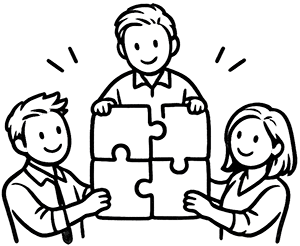
We adopt his CPA (Concrete-Pictorial-Abstract) model. Our kits start with physical beads (Concrete) before moving to symbols (Abstract).
The Bibliography 
The Process of Education (1960).
What if complex concepts could be taught to any child at any stage, provided they are presented in the right way? Jerome Bruner revolutionized pedagogy with the "Spiral Curriculum" and the CPA (Concrete-Pictorial-Abstract) model. He argued that learning is an active process where students construct new ideas based on their current knowledge. By advocating for "scaffolding"—temporary support that is gradually removed as a child gains mastery—Bruner ensured that the leap from physical objects to abstract symbols was never too steep. His legacy teaches us that with the right structural support, no idea is out of reach for a curious mind.
The Kriyaa
Conclusion 
We provide the physical "scaffolding" that makes complex ideas reachable.
Jean Piaget
Kriyaa Collaboration
Our resources are aligned with his Stages of Cognitive Development, ensuring a 4-year-old explores "objects" while a 10-year-old explores "logic."
The Bibliography
The Psychology of the Child (1966).
Children are not just "little adults"; they are active "mini-scientists" who build their own understanding of the world through distinct biological stages. Jean Piaget’s work on cognitive development shifted the focus from the quantity of information a child holds to the quality of their mental structures. He identified how children transition from sensorimotor exploration to logical reasoning, emphasizing that a child’s readiness to learn is dictated by their internal developmental clock. His insights remind us to respect the natural timeline of the brain, ensuring that educational tools match the learner’s specific cognitive stage.
The Kriyaa
Conclusion
Kriyaa tools respect the natural biological timeline of a child’s brain.
Lev Vygotsky
Kriyaa Collaboration
We design tools for the Zone of Proximal Development (ZPD)—challenges that are just right for a child to solve with a little help from our guides.
The Bibliography
Mind in Society (1978).
Real growth happens in the "sweet spot" between what a child can do alone and what they can achieve with just a touch of guidance. Lev Vygotsky’s "Zone of Proximal Development" (ZPD) emphasizes that learning is a fundamentally social act. Unlike theorists who focused on independent discovery, Vygotsky highlighted the role of language and social interaction in cognitive growth. He viewed tools—whether physical or linguistic—as cultural mediators that expand a child’s potential. His work proves that we don't just learn from others; we learn with them through shared discovery and dialogue.
The Kriyaa
Conclusion
We facilitate the "social dialogue" between the child, the teacher, and the tool.
Maria Montessori
Kriyaa Collaboration
Like her "Auto-didactic" materials, Kriyaa manipulatives are self-correcting—the child realizes a mistake through the physical fit of the blocks.
The Bibliography
The Absorbent Mind (1949).
What happens when you stop "teaching" and start "preparing the environment"? Maria Montessori discovered that children possess an "absorbent mind" and a natural drive for self-perfection. Her innovation lay in "auto-didactic" materials—tools that provide immediate feedback, allowing a child to recognize and correct their own errors without adult intervention. By fostering independence and respect for the child’s individual pace, Montessori transformed the classroom into a laboratory of self-reliance. Her philosophy underscores the power of letting a child move their hands to unlock their mind, turning every mistake into a private moment of mastery.
The Kriyaa
Conclusion
We empower children to be the masters of their own environment.
Reggio Emilia
Kriyaa Collaboration
We champion the "Hundred Languages of Children" through our Loose Parts and Reggio Ateliers.
The Bibliography
The Hundred Languages of Children (1993).
A child has a hundred languages, but the traditional school system steals ninety-nine. Loris Malaguzzi, the visionary behind the Reggio Emilia approach, championed the idea that children express their understanding through endless mediums—painting, building, sculpting, and shadows. He viewed the "environment as the third teacher," suggesting that the physical space should be as intentional and communicative as the educator. By treating children as competent, powerful researchers of their own world, Malaguzzi’s legacy encourages us to provide "loose parts" and open-ended resources that allow a child’s unique voice to flourish.
The Kriyaa
Conclusion
Our kits aren't just toys; they are expressive tools for a child’s unique voice.
Caleb Gattegno
Kriyaa Collaboration
We utilize the power of Cuisenaire Rods and "The Silent Way." By using color-coded, physical manipulatives, we minimize teacher explanation and maximize student investigation in numeracy and literacy.
The Bibliography
The Common Sense of Teaching Mathematics (1970).
The teacher works on the student; the student works on the subject; but only the student does the learning." Caleb Gattegno believed that the educator’s role is to become an invisible facilitator rather than a lecturer. He championed the idea that the human mind is naturally equipped to learn anything if the right "feedback loop" is established. Through his invention of Cuisenaire Rods, he proved that complex mathematical relationships could be discovered by a child simply by playing with proportional blocks. Gattegno’s legacy is a masterclass in the "economy of means," showing that a few simple physical tools can unlock the entire world of mathematics and language, provided the child is the one doing the thinking.
The Kriyaa
Conclusion
We provide the "silent tools" that provoke children into their own realizations, ensuring the learner is always the protagonist.
 +91 88008 70177