Urie Bronfenbrenner
Kriyaa Collaboration 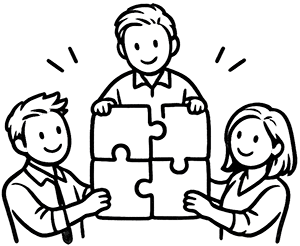
Our Ecological Systems approach bridges Home (Parents), School (Teachers), and the Child.
The Bibliography 
The Ecology of Human Development (1979).
A child’s development cannot be understood in a vacuum; it is shaped by a series of nesting "circles of influence." Urie Bronfenbrenner’s "Ecological Systems Theory" showed that a child is at the centerof a complex ecosystem—from the immediate home and school (Microsystem) to broader cultural values (Macrosystem). He argued that for a child to thrive, the bridges between these systems—like the connection between parents and teachers—must be strong. His work reminds us that education is a 360-degree support system, and no tool is as powerful as a supportive environment.
The Kriyaa
Conclusion 
We create a 360-degree support system for the learner.
Pavlov, Skinner, & Watson
Kriyaa Collaboration
We use Operant Conditioning through immediate feedback. When a child solves a puzzle, the "click" of the piece is the positive reinforcement.
The Bibliography
Science and Human Behavior (Skinner, 1953).
Ivan Pavlov
Can we "train" the brain to love learning? Ivan Pavlov’s discovery of "Classical Conditioning" revealed how external stimuli can trigger involuntary responses. While often associated with biology, his work in education underscores the power of association. When a learning environment is consistently paired with joy, safety, and curiosity, the learner develops a positive "conditioned response" to education itself. Pavlov’s insights remind us that the emotional atmosphere of a classroom is just as important as the curriculum; we are always conditioning the heart while we teach the mind.
B.F. Skinner
Behavior that is followed by a "reward" is more likely to be repeated. B.F. Skinner’s "Operant Conditioning" introduced the world to the power of reinforcement. In the classroom, this translates to the "click" of a puzzle piece fitting or the immediate feedback of a self-correcting tool. Skinner believed that learning should be broken down into small, achievable steps that provide frequent moments of success. His legacy is found in the design of any tool that turns the act of discovery into a habit-forming joy, proving that success is the best motivator for further inquiry.
John Watson
"Give me a dozen healthy infants... and I'll guarantee to take any one at random and train him to become any type of specialist." While controversial, John Watson’s "Behaviorism" brought a rigorous, scientific focus to how the environment shapes human action. He stripped away the "mysterious" inner workings of the mind to focus on observable behavior. His impact on education lies in the realization that the environment is a powerful architect of potential. Watson’s work emphasizes that by intentionally designing the world a child interacts with, we can influence the skills and habits they develop.
The Kriyaa
Conclusion
We turn the success of discovery into a habit-forming joy.
Albert Bandura
Kriyaa Collaboration
Through our Teacher & Parent Labs, we focus on "Modeling." Adults show the joy of inquiry, and children imitate.
The Bibliography
Social Learning Theory (1977).
Most of what we learn, we learn by watching. Albert Bandura’s "Social Learning Theory" bridged the gap between behaviorism and cognitive psychology by proving that "modeling" is the primary engine of human growth. Through his famous Bobo Doll experiment, he showed that children don't just react to rewards; they observe and imitate the behaviors, attitudes, and emotional reactions of others. Bandura’s insights remind us that the teacher—and the parent—is the ultimate "living manipulative." If we want children to be curious, we must model curiosity ourselves.
The Kriyaa
Conclusion
Learning is a social act of observation and inspiration.
Confucius
Kriyaa Collaboration
We live the mantra: "I hear and I forget. I see and I remember. I do and I understand."
The Bibliography
The Analects.
Two thousand years before modern psychology, one philosopher captured the essence of the human mind: "I hear and I forget. I see and I remember. I do and I understand." Confucius believed that virtue and wisdom were not innate but were cultivated through ritual, practice, and persistent action. His philosophy emphasizes the "rectification of names"—the idea that understanding starts with precision and clarity. His timeless wisdom serves as the ultimate "hook" for experiential learning, reminding us that the hand is, and always has been, the primary entry point to the mind.
The Kriyaa
Conclusion
The hand is the primary entry point to the mind.
 +91 88008 70177