John Dewey
Kriyaa Collaboration 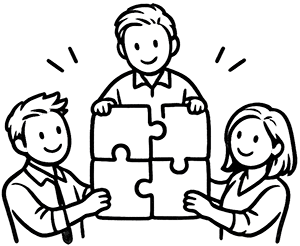
The pioneer of "Learning by Doing." Our entire company philosophy is a reflection of Dewey's laboratory school.
The Bibliography 
Experience and Education (1938).
"Education is not preparation for life; education is life itself." John Dewey, the father of progressive education, believed that the classroom should be a miniature community where children learn through lived experience. He rejected the idea of students as passive listeners, arguing instead for a "laboratory" approach where inquiry and action are central. For Dewey, knowledge is a byproduct of solving real-world problems. His legacy is the foundation of hands-on learning, reminding us that we don't learn from experience alone—we learn from reflecting on that experience.
The Kriyaa
Conclusion 
Knowledge is not a gift; it is a discovery made through action.
David Kolb
Kriyaa Collaboration
We facilitate his Experiential Learning Cycle: Experience → Reflection → Conceptualization → Testing.
The Bibliography
Experiential Learning (1984).
True understanding is a cycle, not a destination. David Kolb’s "Experiential Learning Model" maps the four-stage journey of mastery: having a Concrete Experience, reflecting on it, forming Abstract Concepts, and then Testing those concepts in new situations. Kolb’s work highlights that every learner has a preferred starting point in this cycle, but true mastery requires traveling through all four. His insights prove that for an "aha!" moment to stick, the learner must have the opportunity to take what they’ve felt and turn it into a theory they can test.
The Kriyaa
Conclusion
Every Kriyaa box is an invitation to test a new theory.
Paulo Freire
Kriyaa Collaboration
We move away from "Banking Education" (depositing facts) to Problem-Posing education.
The Bibliography
Pedagogy of the Oppressed (1968).
Education is either a tool for conformity or a tool for transformation. Paulo Freire famously critiqued the "Banking Model" of education, where teachers "deposit" facts into the "empty accounts" of students. Instead, he proposed "Problem-Posing Education," where teachers and students engage in a mutual dialogue to investigate the world. Freire’s work emphasizes that learners must be active co-creators of their reality. His legacy teaches us that the ultimate goal of learning is "conscientization"—giving children the tools to not only read the word but also to read and change their world.
The Kriyaa
Conclusion
We treat children as active co-creators of their knowledge.
Rube Goldberg
Kriyaa Collaboration
We embrace the STEM Challenge mindset. Our "Loose Parts" kits and construction sets encourage children to build complex, multi-step chain reactions to solve simple problems.
The Bibliography
Rube Goldberg: Inventions! (Posthumous Collection).
Why solve a problem in one step when you can use twenty? While Rube Goldberg was a cartoonist, his "inventions" became a cornerstone of modern engineering education and the "Maker Movement." His philosophy celebrates the "over-complicated machine," which teaches children the fundamental principles of physics—force, motion, energy transfer, and cause-and-effect—through whimsical trial and error. By turning a simple task into a complex mechanical journey, Goldberg’s influence encourages "divergent thinking" and resilience. His impact reminds us that the process of building is far more educational than the final result, turning every engineering failure into a vital lesson in persistence and creative problem-solving.
The Kriyaa
Conclusion
We turn the classroom into a laboratory of "chain-reaction" thinking, where every kit is an invitation to experiment, fail, and innovate.
 +91 88008 70177