A Good Curriculum Is Not Enough
A Good Curriculum Is Not Enough
How philosophy, curriculum, and pedagogy work together to create meaningful learning
It begins with one question
It begins with one question
A child notices leaves falling from a tree and asks, “Why do leaves fall?”
The question could be answered in a sentence and forgotten. It could also open a connected learning journey. What happens next depends on the relationship between philosophy, curriculum, and pedagogy.
These terms are often reduced to a simple memory aid: philosophy is the “why”, curriculum is the “what”, and pedagogy is the “how”. That shorthand is useful, but the ideas are richer. Their alignment can be seen in what children actually experience.
Philosophy: what do we believe?
Philosophy: what do we believe?
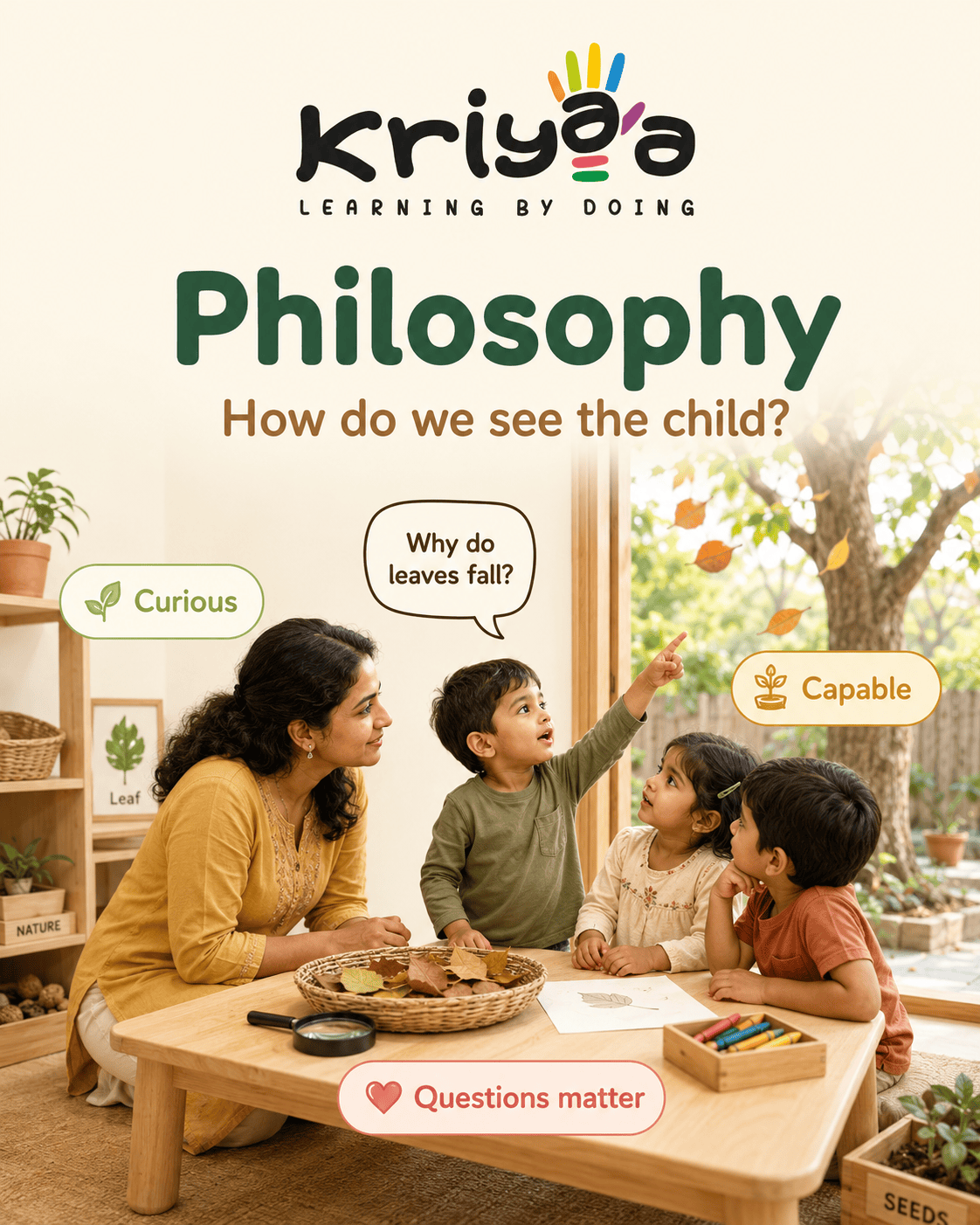
Educational philosophy concerns our beliefs about children, learning, knowledge, the purpose of education, and the roles of adults, families, and community.
In the leaf example, the key question is: How do we see the child? If we see young children as passive recipients or too young for complex ideas, the adult is likely to provide the answer. If we see them as curious, capable meaning-makers, the teacher listens, values the question, and creates an opportunity to investigate it through concrete, developmentally appropriate experiences.
Philosophy does not remain in a mission statement. It shapes everyday decisions.
Curriculum: what learning are we intentionally planning?
Curriculum: what learning are we intentionally planning?
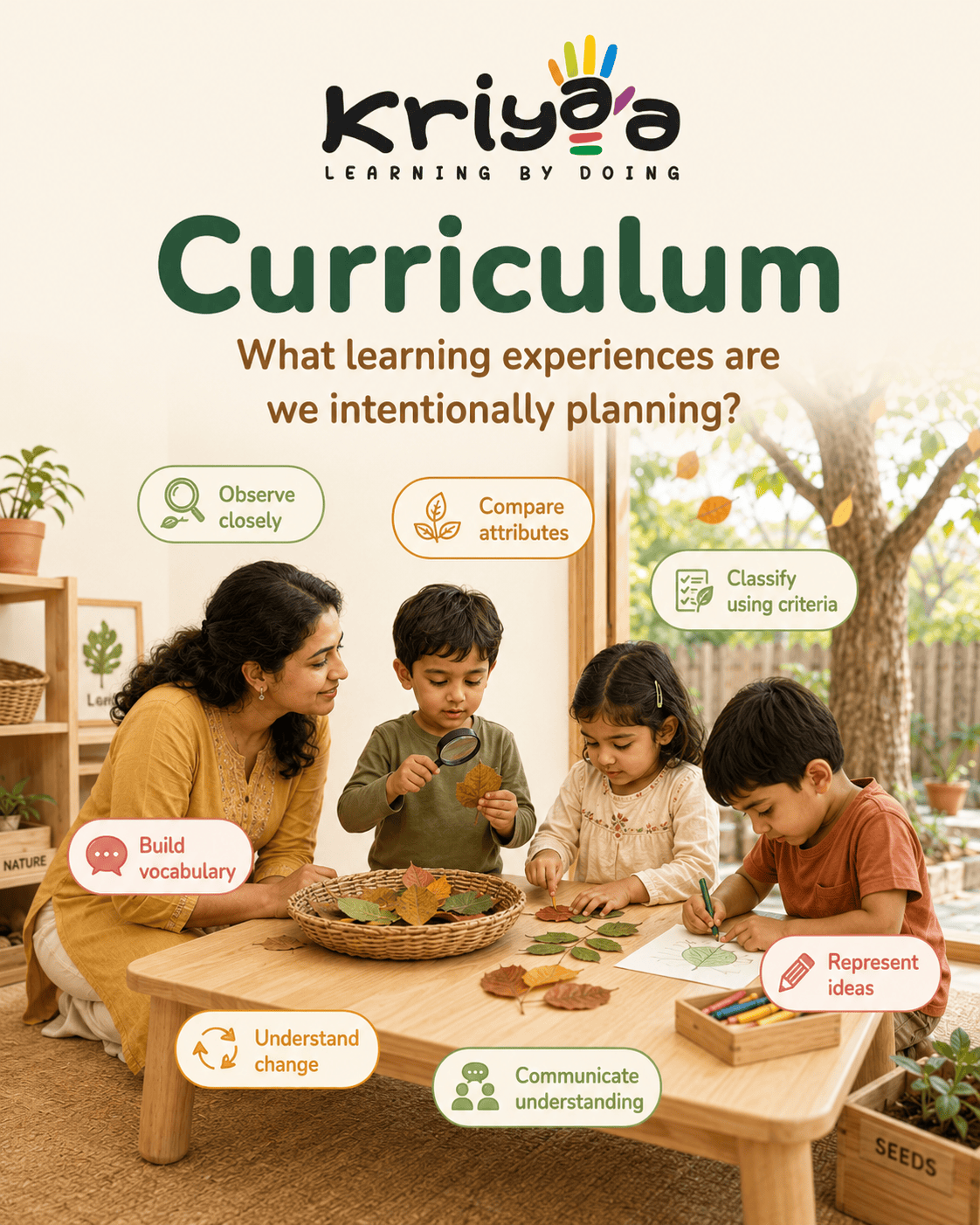
NAEYC defines curriculum as the plans for learning experiences through which children acquire knowledge, skills, abilities, and understanding. Strong curriculum goals are meaningful, culturally and linguistically responsive, and developmentally and educationally significant.
The child’s question is not the curriculum by itself. It provides a meaningful context. The curriculum intentionally connects that question with valued learning goals and progression.
Through a leaf investigation, children may learn to observe closely; compare colours, shapes, and textures; classify using different attributes; develop descriptive vocabulary; recognise patterns of change; represent observations through drawings or charts; communicate findings; and deepen awareness of the natural world.
Curriculum therefore gives the learning journey direction, connection, and continuity. It prevents the experience from becoming a collection of attractive but disconnected activities.
Pedagogy: how will we help these children learn it well?
Pedagogy: how will we help these children learn it well?
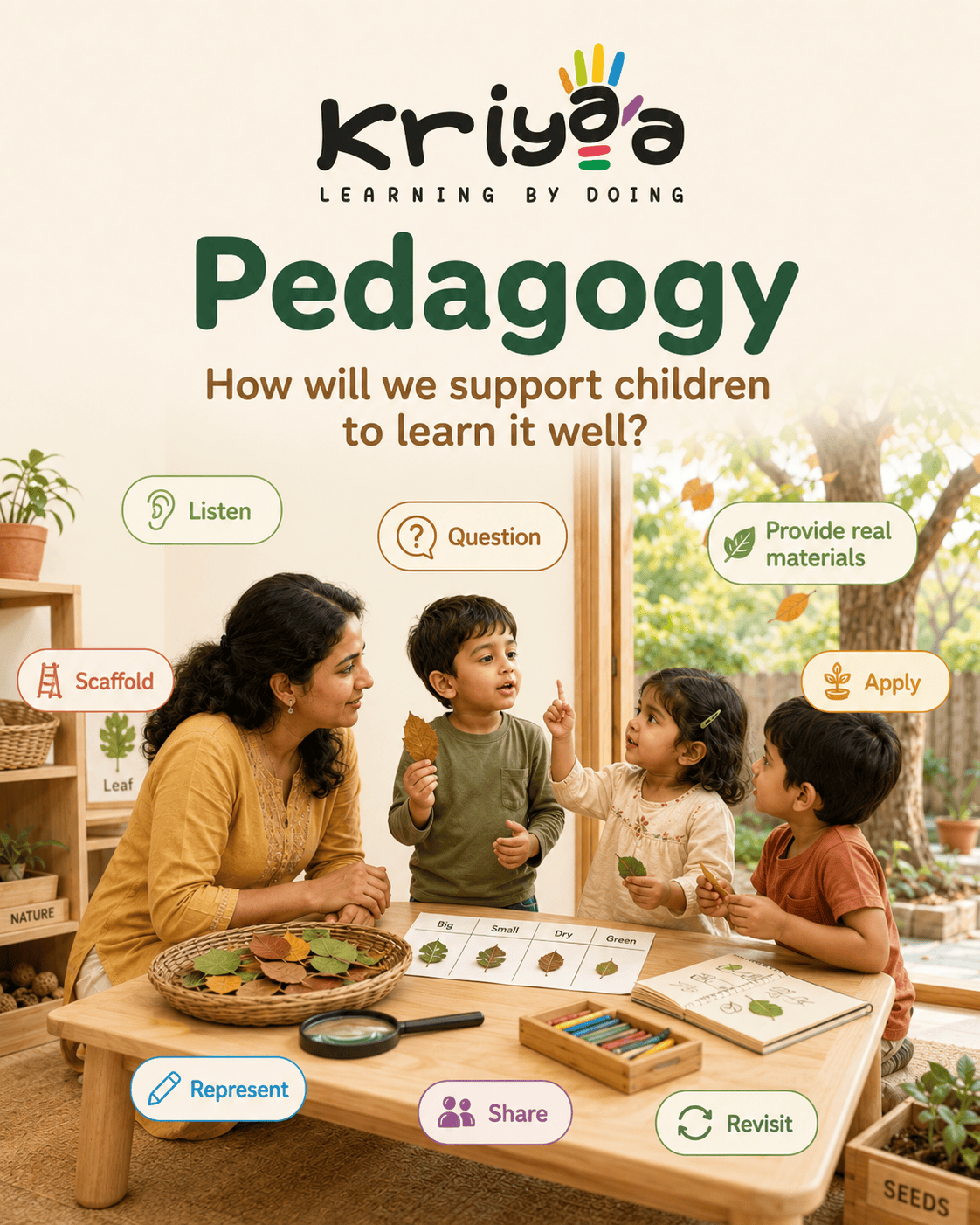
Pedagogy is how educators enact the curriculum through relationships, interactions, questions, explanations, modelling, scaffolding, materials, environments, routines, documentation, feedback, and assessment for learning.
In the leaf investigation, the educator might invite children to collect and compare leaves, introduce precise vocabulary when useful, help them create categories, ask them to explain their reasoning, and offer different ways to represent what they notice. Children might revisit the same tree over several weeks, use their observations to discuss seasonal change, create a visual explanation, and share their findings with families or another group.
Research can inform these decisions, but it rarely supplies one universal method. Effective pedagogy combines evidence with knowledge of the children, the intended learning, culture, context, and ongoing observation.
The real test is the child’s experience
The real test is the child’s experience
Two schools may use the same curriculum and create very different experiences. In one classroom, children may copy a labelled leaf from the board. In another, they may observe, compare, question, classify, represent, explain, and revise ideas.
The difference is not the curriculum name. It is the alignment between beliefs, planned learning, and pedagogy.
Parents can look beyond labels and observe how children participate. Educators can connect learning goals with real experiences and reflect on the effect of their choices. School owners and leaders can ask whether staffing, schedules, environments, professional learning, and monitoring enable the stated philosophy and curriculum to be lived.
The Kriyaa perspective
The Kriyaa perspective
At Kriyaa, we study educational traditions and contemporary research for the principles they reveal—not as labels to copy. We aim to translate those principles into coherent, inclusive, joyful learning experiences.
Philosophy shapes what we value. Curriculum plans and connects the learning journey. Pedagogy shapes how children experience that journey. The clearest evidence of alignment is what children are enabled to notice, question, understand, create, and become.
 +91 88008 70177