
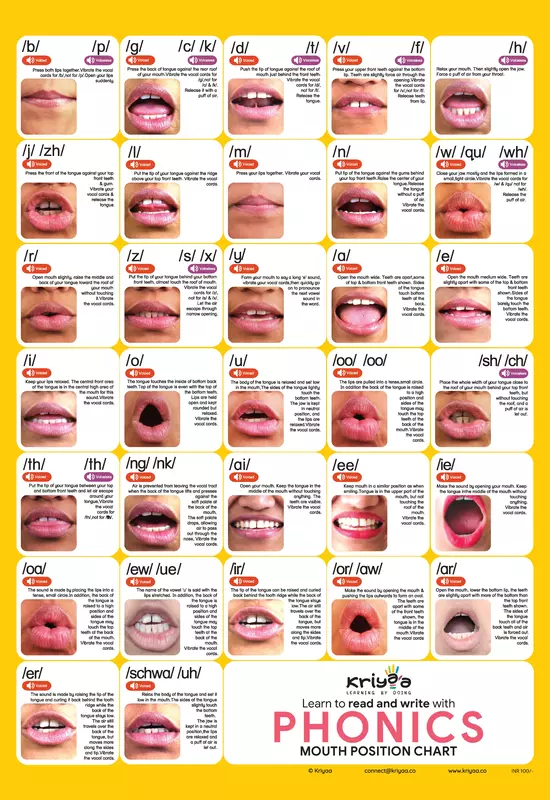
Phonics Mouth Positions Poster
"Phonics Mouth Positions Poster | Ages 3–8
Sturdy classroom poster | Articulation & speech sound formation | Nursery to Grade 2
✔️ Shows How Sounds Are Physically Formed
✔️ Strengthens Articulation & Pronunciation Skills
✔️ Builds Phoneme Discrimination & Sound Awareness
✔️ Supports Listening, Speaking & Self-Monitoring of Speech
✔️ Ideal for Daily Classroom Display & Speech Practice"
₹100.00
Customize
_howToUse
1. Mirror & Match – Pair the poster with a small mirror; learners say a sound and check whether their mouth shape matches the picture. Develops articulation and self-monitoring. 2. Tricky Sound Coach – Focus on sounds learners often confuse (e.g., /th/, /v/, /f/). Strengthens phoneme discrimination. 3. Sound Detective – Say a sound; learners find the matching mouth position on the poster. Builds observation and auditory processing. 4. Pronunciation Roundtable – Each learner picks a sound and demonstrates the mouth shape and an example word. Grows confidence in speaking. Product Details
| Phonics Mouth Positions Poster DESCRIPTION The Phonics Mouth Positions Poster is printed on sturdy, high-quality material designed for everyday classroom display. It shows young learners how speech sounds are physically formed — how lips, teeth, and tongue work together — giving them a clear visual model that strengthens sound awareness and helps develop clearer pronunciation through observation and practice. AGE GROUP Nursery (PP1) | LKG (PP2) | UKG (PP3) | Grade 1 | Grade 2 | Ages 3–8 SKILLS DEVELOPED Sound identification, Phoneme discrimination, Articulation skills, Pronunciation skills, Oral language skills, Listening skills, Auditory processing, Observation skills, Self-monitoring of speech, Confidence in speaking EDUCATIONAL FOCUS Integrates phonological awareness with articulation awareness — helping learners not only hear sounds but also see and feel how they are produced, deepening sound–symbol mastery in a multisensory way. HOW TO USE 1. Mirror & Match – Pair the poster with a small mirror; learners say a sound and check whether their mouth shape matches the picture. Develops articulation and self-monitoring. 2. Tricky Sound Coach – Focus on sounds learners often confuse (e.g., /th/, /v/, /f/). Strengthens phoneme discrimination. 3. Sound Detective – Say a sound; learners find the matching mouth position on the poster. Builds observation and auditory processing. 4. Pronunciation Roundtable – Each learner picks a sound and demonstrates the mouth shape and an example word. Grows confidence in speaking. |